

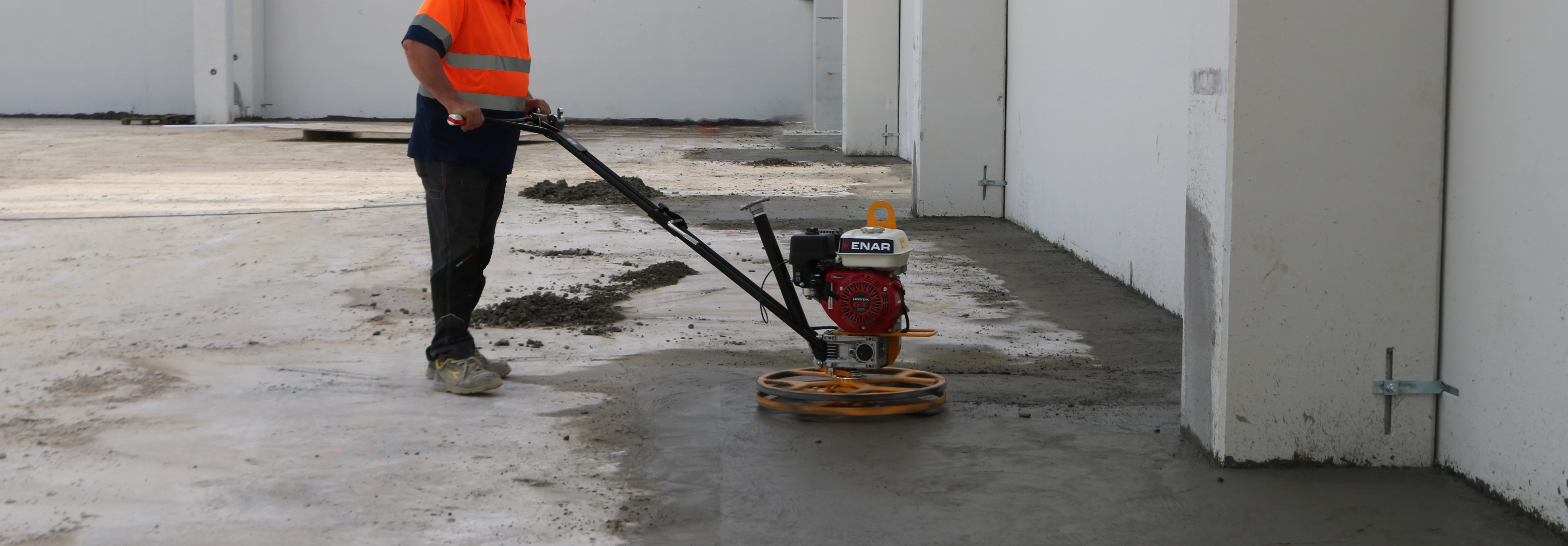
When to Use a Power Trowel: Achieving a Perfect Concrete Finish
When Should You Use a Power Trowel on Concrete?
In industrial flooring, the timing of using a power trowel is critical. It determines whether you achieve a flat, dense, and durable surface — or end up with dusting, poor performance, and customer complaints.
The question “when should I use a power trowel?” is common across projects such as:
- Industrial floors
- Warehouses
- Parking areas
- Workshops
The challenge is that optimal timing depends on multiple factors:
- Concrete setting time
- Temperature and weather conditions
- Mix design
- On-site slab condition
Why timing is the key to a good concrete finish
After pouring and screeding, the concrete goes through several phases: plastic, initial set, final set, hardening. It is during the setting window that the concrete power trowel must be used to densify the wear layer and close the surface.
In industrial floors, exposed to heavy demands (forklift traffic, heavy racking, chemical agents…), a poorly finished surface quickly results in:
- Premature wear and dust formation (cement dust on the surface)
- Lack of flatness, making forklift movement difficult
- Excessive porosity, promoting the absorption of oils, dirty water, or chemicals
- Cracks and scaling in the wear layer, especially if a surface hardener has been applied
Too early: tearing and laitance
If the power trowel is used when the concrete is still too fresh:
- The blades create grooves and tear the surface
- Laitance rises, creating a weak layer rich in water
- Reworking with rake and screed increases, losing the initial flatness
In the long term: dust formation, microcracking, and rapid wear.
Too late: burnt surface and open pores
On the other hand, if you wait too long:
- The surface is already hard: the machine “slides” without really closing the pores
- To compensate, the blades are overly tilted, which burns the concrete (dark, glazed appearance)
- The surface layer becomes fragile and may peel off
- Pores remain open, and the slab absorbs water and dirt
The difficulty lies in starting between these two extremes. This is where simple on-site tests come in.
Recognizing the right moment to start troweling
In theory, it is often stated that finishing can begin 2 to 3 hours after screeding, without exceeding 6–7 hours after pouring, depending on weather and mix design.
In practice, what matters is not the clock but the actual condition of the concrete. The question “when should I trowel?” is answered using a few very concrete indicators.
Simple on-site tests (footprint, bleed water, surface appearance)
1. Footprint test
This is the most commonly used reference, and it works very well:
- Walk gently on the slab with clean shoes
The right moment to start the power trowel is when:
- Your foot does not sink more than 3–5 mm
- The surface shows a slight mark without leaving a hole or bringing up laitance
If the footprint is deep and wet: too early
If it is barely visible or absent: you are already at the upper limit, especially in hot conditions
Start in the most advanced areas of the slab (thin zones, near joints or wind-exposed edges) and then move toward thicker or shaded areas.
2. Observation of bleed water
After vibrating screed finishing, the concrete “sweats.” This is bleed water rising to the surface, and while it is visible:
- • Do not use the power trowel
- • You risk sealing this water into the surface, creating a weak and highly porous layer
The ideal starting point is just after this water film disappears uniformly, when the surface becomes matte but is still slightly damp to the touch.
3. Surface appearance and reaction
Complete your checks with:
- Visual aspect: matte, uniform surface, no water reflections, no dry crust
- Finger test: when pressing firmly, the finger leaves a very slight mark without sinking; the paste sticks little
- Scratch test: when scraping with a spatula or hand trowel, the surface offers slight resistance without tearing “waves” of mortar
When these three groups of signals align, the first troweling pass can begin.
The different passes with the power trowel
On a standard industrial slab, it is generally planned:
- 1 to 2 floating passes (with disc or float blades)
- 1 to 3 finishing passes (with slightly tilted finishing blades)
The exact number depends on:
- Flatness and appearance requirements
- The presence or absence of a surface hardener
- Machine size (600, 900, 1200 diameter, twin trowel)
- Concrete setting time: the faster the setting, the faster you must react between passes
ENAR TIFON power trowels feature blade pitch adjustment and accessories (discs, float or finishing blades) allowing all stages to be completed with the same machine.
First “floating” pass
Objective: close the surface, embed aggregates, bring paste to the surface for later finishing.
1. Equipment
Install a floating disc or completely flat float blades (zero or near-zero pitch).
On ENAR TIFON models, adjustment is made via a crank accessible from the handle.
2. Machine settings
- Moderate engine speed (medium rpm)
- Horizontal blades to avoid tearing
Check the dead-man system and controls before entering the slab.
(All ENAR trowels are equipped with this safety system, which stops the machine if the operator releases the handle.)
3. Paths and overlaps
- Move at a steady speed, slightly faster than walking pace
- Overlap each pass by about 50% of the machine width
- Work in one direction, then cross at 90° on the next pass
4. Specific areas
- Near walls or columns: a compact Ø 600 mm trowel like the TIFON 600 is easier to maneuver
- Edges and openings can be prepared with a manual trowel before machine work
At the end of this phase, the surface must be closed, free of screed marks, with a smooth appearance but still slightly “soft” under finger pressure.
Finishing passes
Objective: achieve the desired slab finish (closed surface, even mirror effect), while increasing surface density.
1. Switching to finishing blades
- Remove the disc or set blades for finishing
- Slightly tilt the blades to apply more pressure
2. Multiple passes
- Perform at least 2 to 3 passes, crossing paths systematically
- Gradually increase blade pitch without being too aggressive to avoid burning the surface
3. Speed management
For TIFON 900 and 1200, rotation speed (approx. 120–135 rpm depending on version) provides a good balance between productivity and finish quality.
On smaller areas, Ø 600 machines are easier to control.
4. Very large surfaces
Twin trowels like TIFON 908 DUPLA allow fast coverage while maintaining excellent flatness.
The final pass must be done on well-set concrete: the surface barely marks, the sound is sharper, and the final appearance appears.
Common mistakes to avoid
1. Starting too early
- Deep footprints, laitance, surface tearing
- Need to re-screed, loss of flatness
2. Waiting too long
- Surface too hard
- Over-tilting blades causes fragile surface
3. Incorrect blade adjustment
- Too much angle early → defects
- Too little angle late → low density
4. Neglecting edges
- Weak zones and damage
5. Poor overlap
- Visible bands and uneven finish
6. Ignoring safety
- Always use PPE
- Ensure ergonomic setup
Adapting timing to temperature and mix
Hot weather
- Faster setting
- Shorter working window
Cold weather
- Slower setting
- Risk of weak surface layers
Mix design
- Fast mixes → shorter window
- Rich mixes → higher burn risk
Which ENAR Power Trowel Models for Your Projects?
ENAR offers a complete range of TIFON power trowels.
Small and Medium Areas
TIFON 600 – Ø 600 mm, petrol, approx. 52 kg, foldable handle.
Ideal for technical rooms, areas around columns, and slab edges.
Large Areas
TIFON 900 or TIFON 1200 – Ø 900 and 1200 mm, HONDA or ENAR engines up to 13 hp.
High productivity and stability.
Very Large Areas
TIFON 908 DUPLA – twin trowel, Ø 900 mm, 24 hp engine.
Designed for logistics platforms and large surfaces.
Indoor Work and Low-Emission Environments
TIFON E-BATT - Meets the requirements of low-noise and sustainable construction sites.
- Ø 600 and 900 mm models
- Up to 60 minutes autonomy
- Zero emissions
- Low noise levels
- Dead-man safety system
Summary
Knowing when to use a power trowel is not determined by chance or by the clock alone.
It is the observation of the concrete (footprint, bleed water, surface condition), combined with proper execution and the use of suitable equipment — such as the ENAR TIFON range — that ensures dense, flat, and durable industrial slabs, in line with the requirements of the French market.

Related News
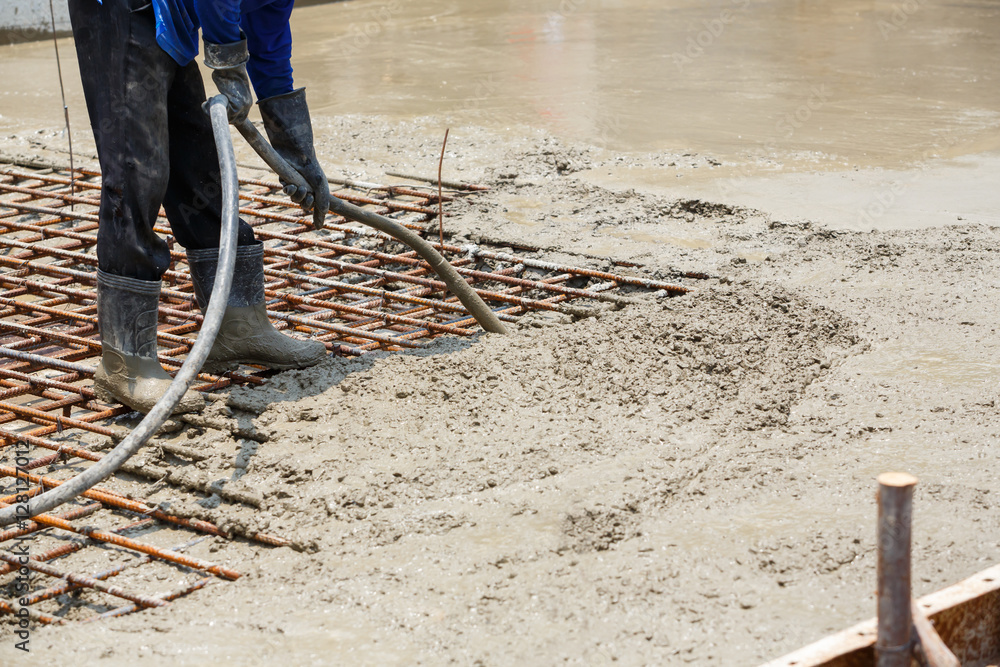
5 Benefits of High-Frequency Vibration
.jpg)
.jpg)
Related Products
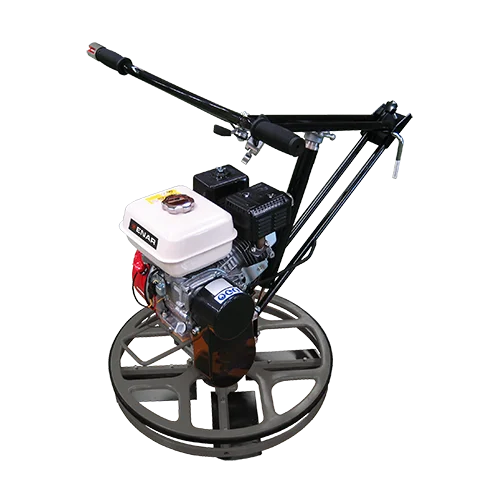 TIFON 600
Power Trowel
TIFON 600
Power Trowel
Power Trowel
.png) TIFON 900
Power Trowel
TIFON 900
Power Trowel
Power Trowel
.png) TIFON 1200
Power Trowel
TIFON 1200
Power Trowel
Power Trowel
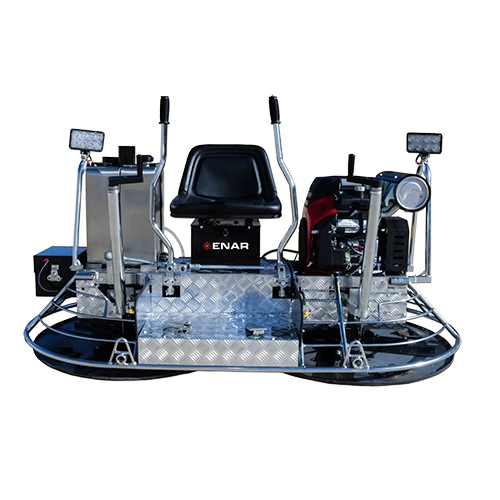 TIFON 908 DOUBLE
Ride-on Power Trowel
TIFON 908 DOUBLE
Ride-on Power Trowel
Power Trowel
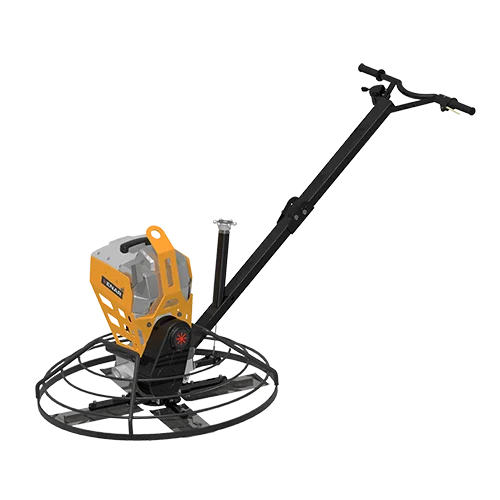 TIFON E-BATT
Power Trowel
TIFON E-BATT
Power Trowel
Power Trowel