

Soil Types in Construction: A Guide to Effective Compaction | ENAR
Soil compaction is one of the most important processes in any construction project. A poorly compacted base can lead to settlement, cracking, pavement deformation, and costly repairs in the long term. That is why, before selecting compaction equipment, it is essential to answer a key question: what type of soil are we going to compact?
Not all soils react in the same way to vibration, impact, or pressure. Understanding the characteristics of the ground helps contractors choose the right equipment, improve jobsite productivity, and achieve the required compaction levels more efficiently.
Understanding Soil Type: The First Step Towards Effective Compaction
The compactability of a soil depends primarily on four factors:
- Soil type
- Particle shape and surface texture
- Particle size distribution (gradation)
- Moisture content
These factors determine how the ground will respond to the compaction process and which technology will deliver the best results.
Correctly identifying the soil not only helps in selecting the right equipment but also reduces the number of passes required, optimizes working time, and improves overall project profitability.
Main Soil Types in Construction
1- Granular or Non-Cohesive Soils
Granular soils are mainly composed of gravel, crushed stone, and sand, with a low percentage of fine particles.
Their main characteristics include:
- High permeability
- Good drainage capacity
- Fast drying
- Excellent load-bearing capacity once compacted
Because there is little cohesion between particles, these materials respond very well to vibration. During compaction, the particles rearrange themselves and fill void spaces, increasing soil density efficiently.
For this reason, granular soils are commonly found in road construction, industrial platforms, and applications where high load-bearing capacity is required.
2- Cohesive Soils
Cohesive soils mainly consist of silts and clays. Their particles are extremely fine and exhibit strong bonding forces.
They are characterized by:
- Low permeability
- High sensitivity to moisture
- Tendency to expand when absorbing water
- Greater difficulty in achieving uniform compaction
Unlike granular soils, vibration alone is often not enough. These materials require a combination of impact, pressure, and kneading action to reduce voids and remove trapped air and water.
3- Mixed Soils
Mixed soils are the most common soils found on construction sites.
They combine coarse and fine particles in varying proportions, meaning their behavior depends on their specific composition.
Well-graded mixed soils generally provide excellent compaction results because smaller particles fill the gaps between larger ones, allowing higher density levels to be achieved.
How to Identify Soil Type on Site
Although laboratory testing remains the most accurate method, a preliminary visual assessment can often be carried out directly on site.
| Soil type | | Visible Characteristics |
| Sand | Loose, visible particles |
| Gravel | Coarse, highly draining material |
| Clay | Fine, plastic, sticky texture |
| Silt | Powdery appearance and high moisture retention |
| Mixed Soil | Combination of different particle sizes |
Another key factor to consider is moisture content.
Excessively dry soils make particle rearrangement more difficult during compaction, while overly wet soils can lose stability and significantly reduce compaction efficiency.
Which Equipment Should You Use for Each Soil Type?
Choosing the right compaction equipment is just as important as identifying the soil itself.
Rammers: The Best Solution for Cohesive Soils
Rammers are specifically designed for clay, silt, and fine-grained materials.
Their high impact force and ability to transmit energy deep into the ground help break soil cohesion and deliver excellent results in trenches, foundations, and confined areas.
They are also ideal for applications requiring intensive compaction in limited spaces.
Vibratory Plates: Maximum Efficiency on Granular Soils
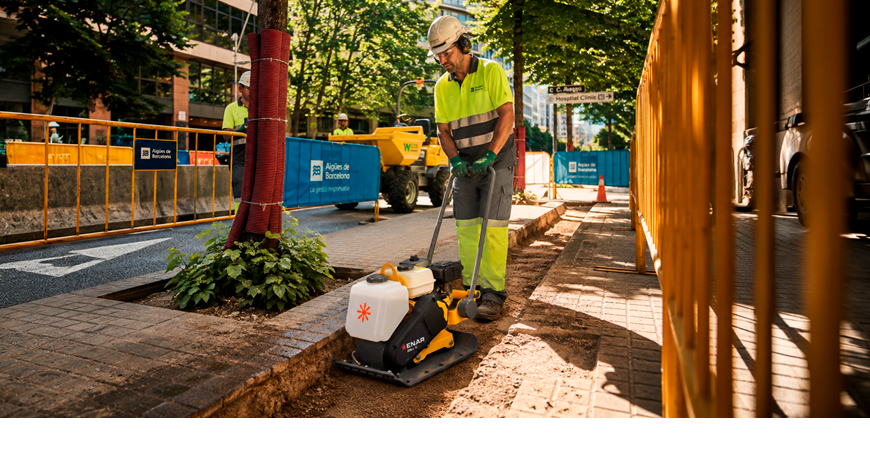
Vibratory plates excel when compacting sand, gravel, and other non-cohesive materials.
Vibration reduces friction between particles and promotes their rearrangement, quickly achieving high density levels.
Depending on the application, contractors can choose between:
- Vibratory plates, ideal for small and medium-sized areas.
- Reversible vibratory plates, recommended for thicker layers and more demanding applications.
Rollers: Productivity on Large Areas
When large surfaces need to be compacted, rollers deliver maximum productivity.
They are particularly effective for:
- Road construction
- Parking areas
- Industrial platforms
- Urban development projects
- Large-scale earthworks
Depending on the soil type, rollers can be equipped with smooth drums or specialized configurations designed for cohesive materials.
Proper Compaction Makes the Difference
Insufficient compaction can lead to problems that may only become visible months or even years after the project has been completed:
- Differential settlement
- Cracks in structures and pavements
- Reduced load-bearing capacity
- Increased maintenance costs
On the other hand, properly executed compaction improves ground stability, reduces permeability, and provides a solid, durable foundation for any infrastructure project.
By correctly identifying the soil and selecting the appropriate technology, contractors can work more efficiently, reduce costs, and ensure longer-lasting results.
The ENAR compaction range, including rammers, vibratory plates, and rollers, offers solutions for a wide variety of applications, helping construction professionals achieve efficient, reliable, and cost-effective compaction on any type of soil.

.webp)
.webp)
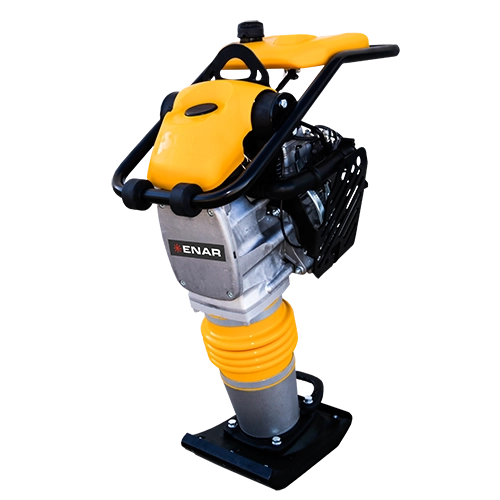 PH
Tamping Rammer
PH
Tamping Rammer
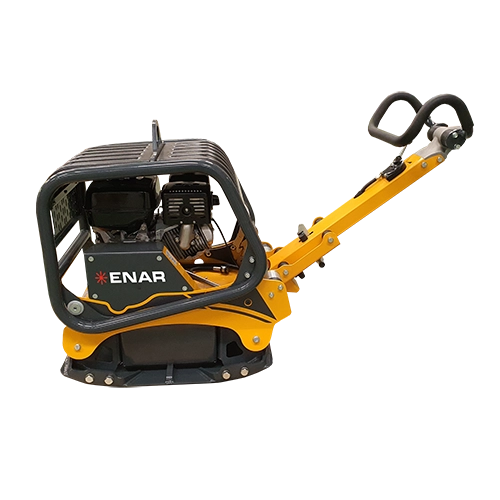 TEN 35
Reversible Plate Compactor
TEN 35
Reversible Plate Compactor
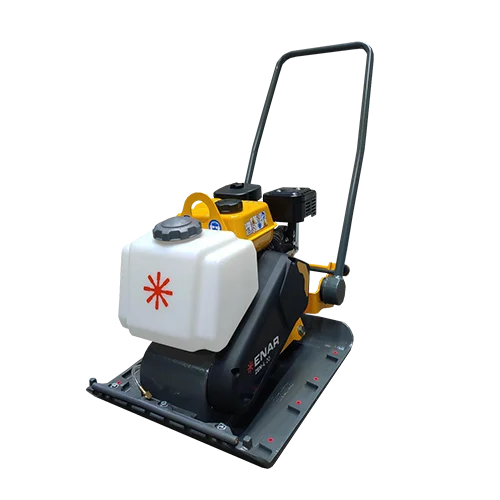 ZEN-L
Single-direction vibratory plate
ZEN-L
Single-direction vibratory plate