

.png)
Reinforced Concrete vs. Fiber-Reinforced Concrete: Is Vibration Still Essential? | ENAR
Reinforced Concrete, Fiber-Reinforced Concrete, and Vibrated Concrete: Understanding the Basics
On modern construction sites, concrete formulations are evolving rapidly: highly fluid concrete, self-compacting concrete, fiber-reinforced concrete, and more. As a result, it is sometimes assumed that vibration is becoming a thing of the past.
However, regulations and field experience prove otherwise: in the vast majority of cases, reinforced concrete is still vibrated concrete.
Let's take a closer look at:
- When vibration is mandatory.
- In which situations it can be avoided (true self-compacting concrete and certain specific fiber-reinforced formulations).
- How to select the right vibration equipment for your project, with practical examples from the ENAR range.
Reinforced Concrete: The Structural Standard
Reinforced concrete is concrete that contains steel reinforcement designed to withstand tensile stresses.
In practice, this includes:
- Foundations, strip footings, and footings.
- Columns, walls, slabs, and beams.
- Civil engineering structures.
Vibrated Concrete: The Traditional Placement Method
The term vibrated concrete refers to concrete that is mechanically compacted through vibration using equipment such as internal vibrators, external vibrators, or vibrating screeds.
Proper vibration is essential to:
- Ensure correct encapsulation of reinforcement.
- Prevent surface defects.
- Achieve the required strength and durability.
Professional recommendations generally follow the same principle: all cast-in-place concrete should be vibrated, except for self-compacting concrete.
Fiber-Reinforced Concrete: A Material That Does Not Always Replace Reinforcement
Fiber-reinforced concrete contains steel, synthetic, or mineral fibers designed to improve crack control and enhance certain mechanical properties.
Typical applications include:
- Industrial floors, roads, and parking areas.
- Residential slabs, terraces, and garages, where fibers may partially or completely replace welded mesh reinforcement.
- Precast elements and Ultra-High Performance Fiber-Reinforced Concrete (UHPFRC).
Vibrating Reinforced Concrete: When Is It Non-Negotiable?
For the vast majority of reinforced concrete projects, vibration remains essential.
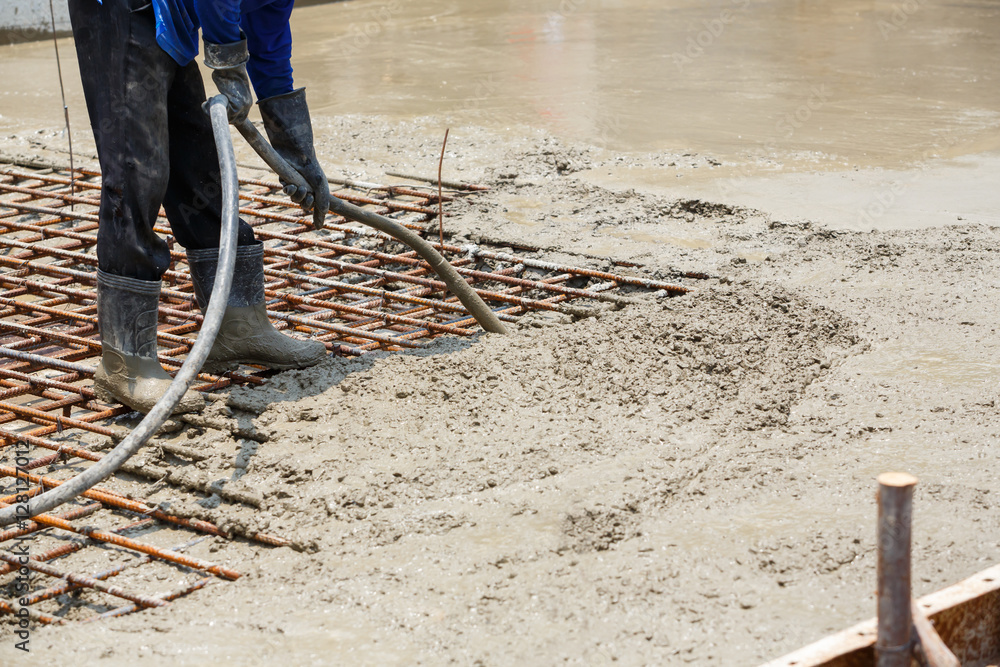
Whenever conventional reinforced concrete (typically S2, S3, or even S4 consistency) is placed in footings, raft foundations, walls, columns, beams, suspended slabs, or balconies, vibration is required to remove entrapped air, allow the concrete to flow through congested reinforcement, ensure proper concrete-to-steel bond and cover, and prevent honeycombing, voids, and surface defects.
Building standards also establish reinforcement spacing requirements to ensure sufficient room for concrete placement, precisely because the concrete is expected to be vibrated.
Highly Fluid Reinforced Concrete That Is Not Self-Compacting: Should It Be Vibrated?
Concrete suppliers increasingly offer highly workable or very plastic concretes (S4 and S5), often promoted as easy-to-place solutions.
However, unless the concrete is explicitly specified as Self-Compacting Concrete (SCC) and the technical documentation clearly states that vibration is not required, the general recommendation remains the same: vibrate the concrete.
Why?
Because highly fluid concrete may appear to flow well while still retaining significant amounts of trapped air. Reinforcement, embedded items, sleeves, and openings create areas that are difficult to fill properly without vibration.
Insufficient compaction is often not detected until formwork removal or until defects such as cracking, spalling, or reinforcement corrosion begin to appear.
Highly Fluid but Poorly Compacted Concrete: A Real Risk
Even concrete that appears highly fluid can suffer from inadequate compaction, leading to serious defects such as:
- Honeycombing behind reinforcement cages.
- Air pockets around embedded items and openings.
- Poorly covered reinforcement vulnerable to corrosion.
Technical guidelines on concrete vibration indicate that vibration duration depends on concrete consistency, placement volume, and reinforcement density.
Vibration should stop when:
- The concrete no longer settles.
- Air bubbles stop rising to the surface.
- A thin, uniform layer of laitance appears.
- The sound of the vibrator stabilizes.
On construction sites, many defects can be traced back to two common mistakes:
- Assuming that a highly fluid concrete does not require vibration.
- Using the vibrator to move concrete rather than using it solely for compaction.
Choosing the Right Equipment for Reinforced and Fiber-Reinforced Concrete
The quality of concrete consolidation largely depends on selecting the most suitable vibration equipment for the application.
In conventional reinforced concrete elements such as footings, beams, columns, and walls, internal poker vibrators remain the most widely used solution. They effectively remove entrapped air, improve reinforcement coverage, and ensure uniform concrete consolidation.
For highly fluid concrete and heavily reinforced structures, high-frequency vibrators are often the preferred option. Their higher vibration speed helps fluidize the concrete more efficiently, facilitates flow around reinforcement, and improves air release without requiring excessive vibration times.
In fiber-reinforced concrete, vibration is still necessary in most applications. However, excessive vibration should be avoided, as it may promote segregation or affect the uniform distribution of fibers within the mix. For this reason, selecting the correct vibrator diameter and applying controlled vibration times is generally more important than increasing vibration intensity.
For slabs and floor construction, especially when working with relatively thin sections, vibrating screeds and surface vibrators provide efficient consolidation while simultaneously improving levelness before the finishing stage.
Finally, in precast production or complex formwork configurations where poker vibrators cannot easily be inserted, external form vibrators offer an effective solution by transmitting vibration through the formwork itself, ensuring proper consolidation and high-quality finishes.
In short, there is no universal rule stating that "fiber-reinforced concrete requires a high-frequency vibrator." The correct choice depends on concrete consistency, reinforcement density, fiber content, element geometry, and the required finish quality. The objective is not to vibrate more, but to vibrate correctly with the most appropriate equipment for each application.
ENAR offers a comprehensive range of vibration solutions:
- Internal concrete vibrators (pendulum, high-frequency, and pneumatic models).
- External vibrators for formwork and precast applications.
- Portable battery-powered solutions.
- Electronic converters, electric motors, and petrol engines.
Whether working with reinforced concrete, fiber-reinforced concrete, or highly fluid mixes, the objective is not to eliminate vibration, but to master it and adapt it to each application.
By choosing reliable, high-performance vibration equipment, you safeguard the quality of your structures, keep projects on schedule, and protect your company’s reputation from one jobsite to the next. The choice is yours: treat vibration as just another requirement—or turn it into a true quality assurance tool.

Related News
.jpg)
.png)
.webp) i-SPYDER
High-Frequency Electronic Converter
i-SPYDER
High-Frequency Electronic Converter